Profiles guide · Step 1 of 7
Parts of a Brick: A Bricklayer’s Guide
Before you set a profile, it pays to speak the same language. Here is every face and edge of a brick, and why the way it was made matters on the wall.

Profiles guide · Step 1 of 7
Before you set a profile, it pays to speak the same language. Here is every face and edge of a brick, and why the way it was made matters on the wall.
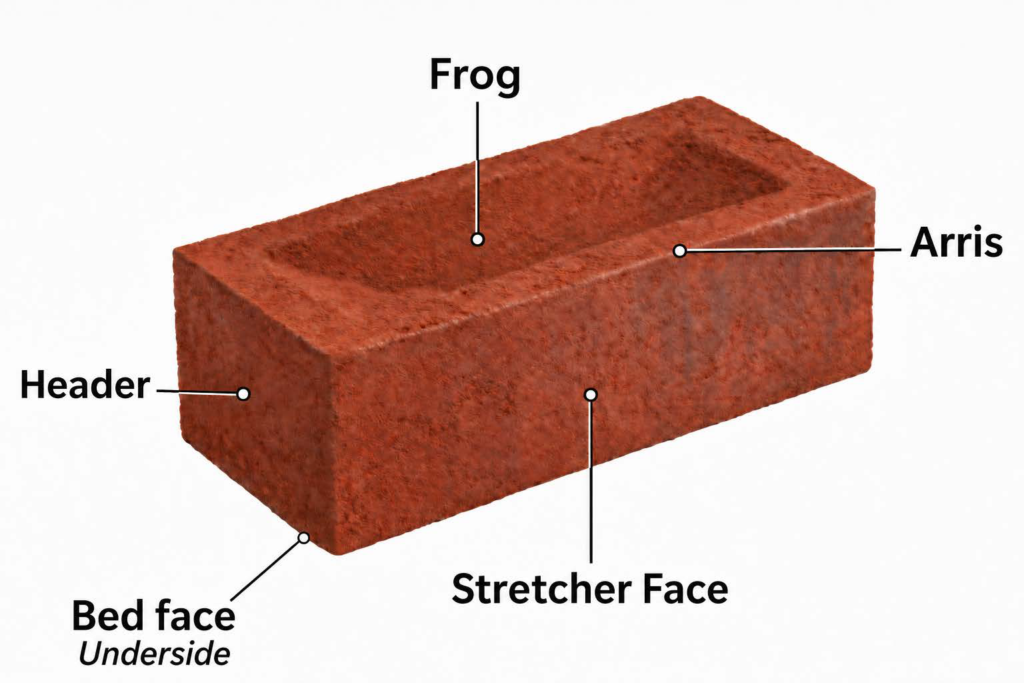
The top front arris, highlighted green, is the edge you lay to the line.
| Term | What it is | Why it matters on site |
|---|---|---|
| Stretcher (face) | The long face that shows on the wall | The face you lay to the line in stretcher bond |
| Header (head) | The end face of the brick | Shows at quoins and in header courses; the Small External Profile Clamp is sized to suit it |
| Bed faces | The top and bottom faces | Sit in the mortar bed joint |
| Arris | Any straight edge where two faces meet | The top front arris is the edge you lay to the line |
| Frog | An indent in the top bed of a pressed or moulded brick | Takes mortar in the bed |
| Perforations | Holes through an extruded brick, bed to bed | Lighten the brick; mortar keys into them |
215 × 102.5 × 65mm — a standard UK brick. With 10mm joints that becomes a coordinating size of 225 × 112.5 × 75mm, the numbers behind UK gauge on the next page.
“Frogged” describes the shape. “Extruded” and “pressed” describe how the brick was made. The two go together in a predictable way.
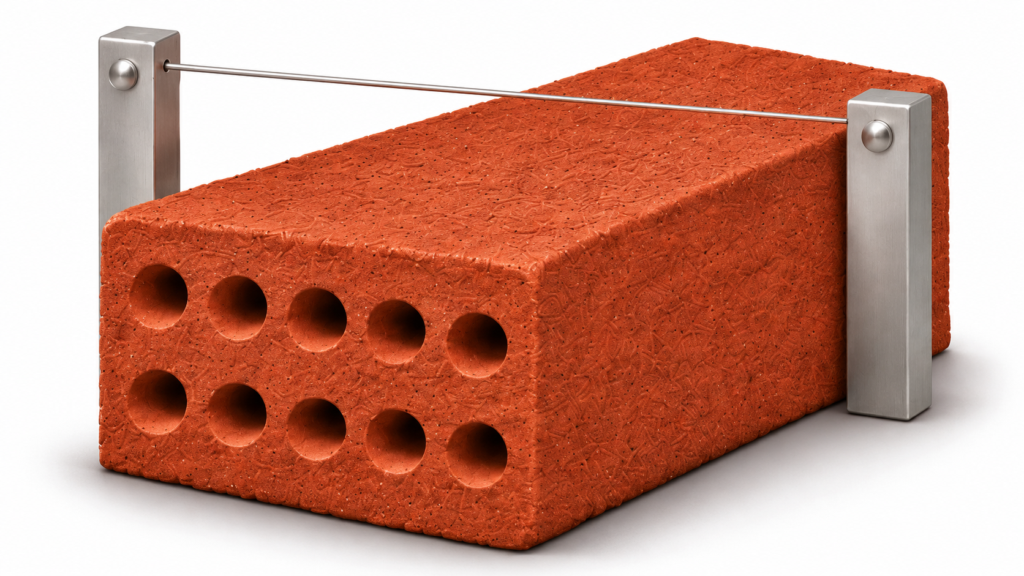
Clay column out of the die, cut by wires.
Clay is pushed through a die as a continuous column, then cut to size with wires. They usually have perforations.
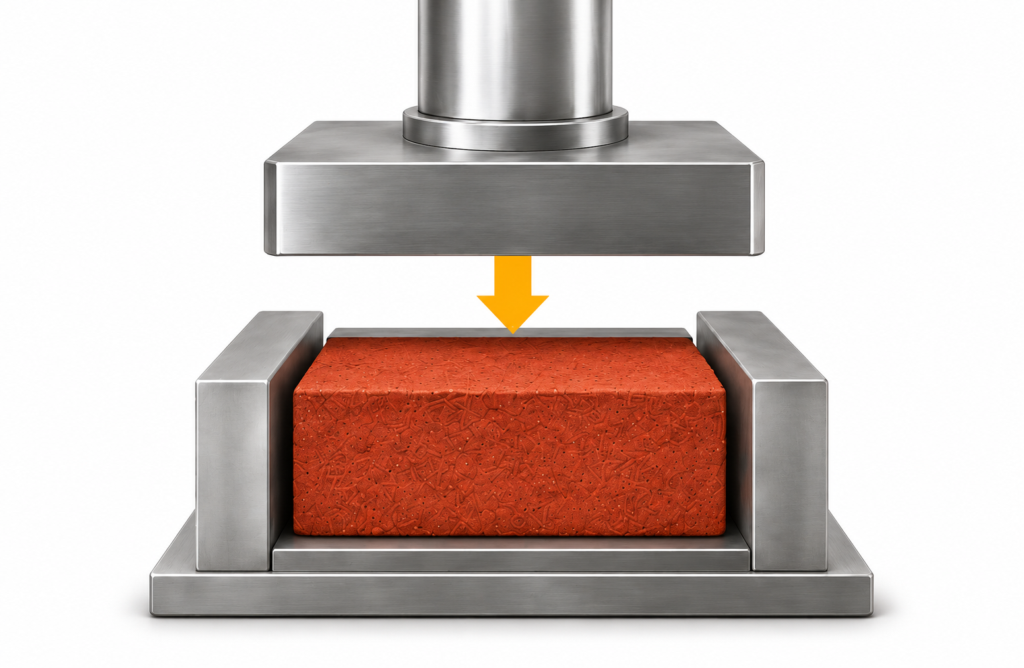
Clay pressed into a mould.
Clay is pressed into a mould. They usually carry a frog in one or both beds.
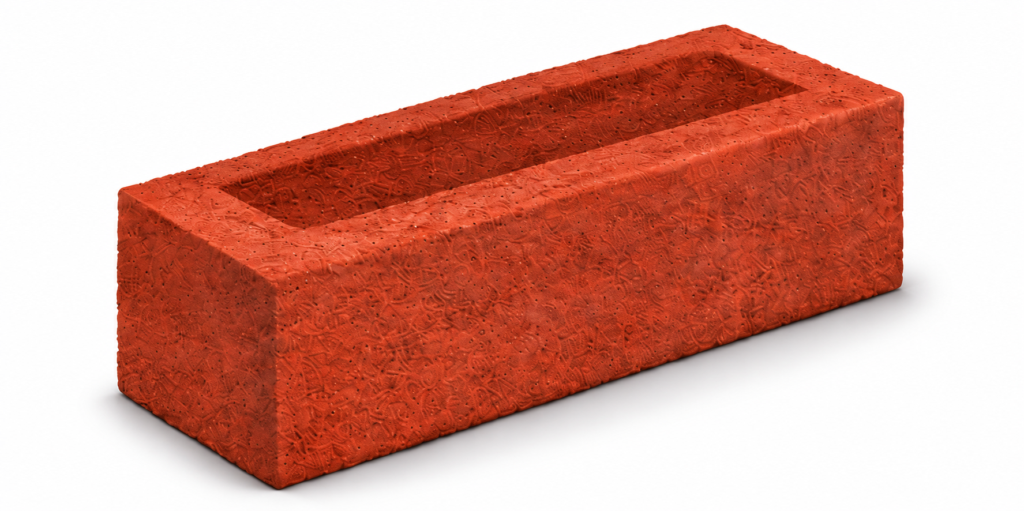
The frog is the indent in the top bed.
Any brick with a frog. Most are pressed or moulded.
Brick terminology adapted from Wienerberger UK (2022) Parts of a brick: brick terminology. Brick sizes from Designing Buildings (2022) Brick sizes. Diagrams: BT Engineering.