Learn · Profiles guide

Bricklaying Profiles: The Complete Guide

A profile does the job the corner used to do. Stand it plumb, mark it to gauge, run your line off it and lay. This guide goes from the parts of a brick to a fully set-up job — the way we explain it to the brickies we work with.

Start the guide Jump to the clamp guide
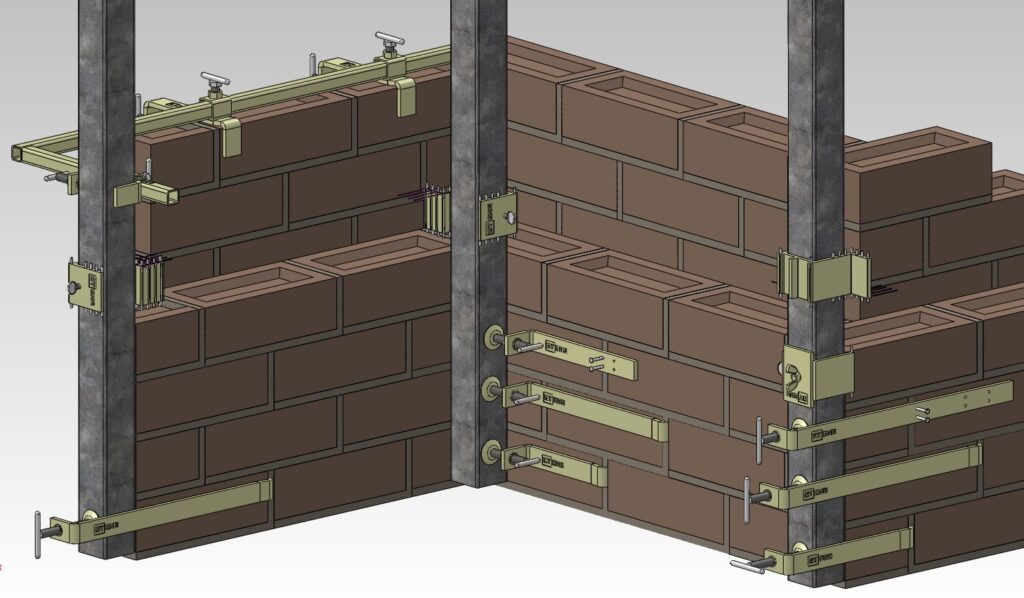
A full set-up: profiles, top clamps, profile clamps and Dori Blocks.

What is a bricklaying profile?

A profile is a straight length of square hollow box section, stood plumb at a corner or the end of a wall. You mark your gauge on it and run your line from it.

50.8mm

2-inch square box section

2400mm

Length

1.6 / 3.2

Wall thickness, mm

Why profiles beat building corners

The old way

A master bricklayer worked round the job building every corner. Three courses first, every brick plumb, level and true, each leg lined up with the corner opposite. Then the corners were racked up to five or ten courses before the gang filled the panels in between.

With profiles

A profile takes the place of that corner. Set one on every corner at the start and the whole gang lays to the line from the first course.

  • No corners to build before the panels go in
  • The line is your level — no put a spirit level on every brick
  • Gauge marked once, checked every course
  • Every profile stays plumb and true to the others all the way up

The guide, step by step

Six short pages, read in order. Each one ends where the next begins.

01

Parts of a brick

Face, header, arris, frog, and how bricks are made.

02

Courses and gauge

The difference, and how a gauge rod helps.

03

Wall types and corners

Cavity, solid and timber frame; quoins and internal corners.

04

Profiles on a new build

From foundations, with nothing to fix to.

05

Profiles on timber frame

Fixing to the frame and the first course.

06

Intermediate profiles and the clamp guide

Long walls, and which clamp for which job.

07

Types of brick joints

Finishing the brickwork: Bucket handle, raked, weather struck, bird’s beak, brushed and sponge: what each looks like, and the tool that makes it.

Built with the trade

BT Engineering has made bricklaying tools in Kirrawee, Sydney, since 1967. Most of the profile tools in this guide began as a problem a bricklayer brought us. For example, the Dean 05 Clamp is named after Dean, the brickie who helped us design it in 2005.

Common questions

What size is a bricklaying profile?

Profiles are 2-inch (50.8mm) square box section, that vary in length from 2.0m to 2.4m long, with a 1.6mm or 3.2mm wall.

Yes — to plumb each profile in both vertical planes (left & right and forward & backwards) . Once the profiles are plumb and marked to gauge, the line does the levelling for every course.

A Dori Block locks onto the profile with a thumb screw. A standard line block is held on by line tension alone, so if the line snaps it falls off — and because the line runs right round the job, so does every other one. Dori Blocks stay where you put them.