Profiles guide · Step 2 of 7
Courses and Gauge: What’s the Difference?
Two words that get used as if they mean the same thing. They don’t, and the difference is what keeps a wall running true from one profile to the next.

Profiles guide · Step 2 of 7
Two words that get used as if they mean the same thing. They don’t, and the difference is what keeps a wall running true from one profile to the next.
You lay it
A course is one horizontal row of bricks, laid. You lay courses.
You measure it
Gauge is a measurement: the height of one brick plus one bed joint. With a standard UK brick (65mm) and a 10mm joint, gauge is 75mm, so four courses rise 300mm. You mark gauge on the profile; you lay courses to it.
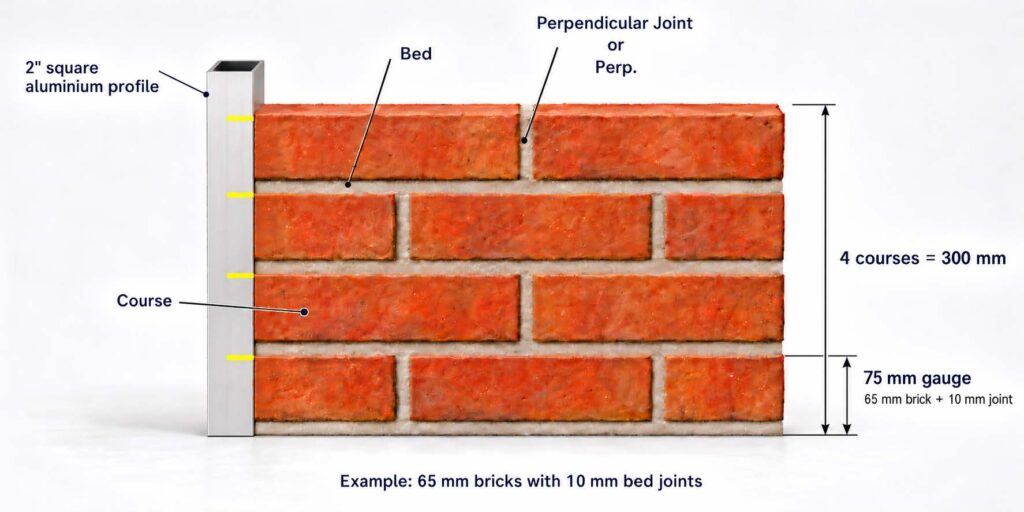
Standard UK brick (65mm) plus a 10mm joint gives 75mm gauge. Four courses rise 300mm.
When you start on an uneven footing or slab, you take up the difference in the bed joints so the courses still run level.
Different batches and makers produce slightly different heights, so the gauge that keeps your joints even changes with them.
BT’s UK gauge rods each carry four gauges. Hold the rod against the wall and find the scale whose marks land on the bed joints — that’s the gauge.
Brick and coordinating sizes from Designing Buildings (2022) Brick sizes. Diagram: BT Engineering.